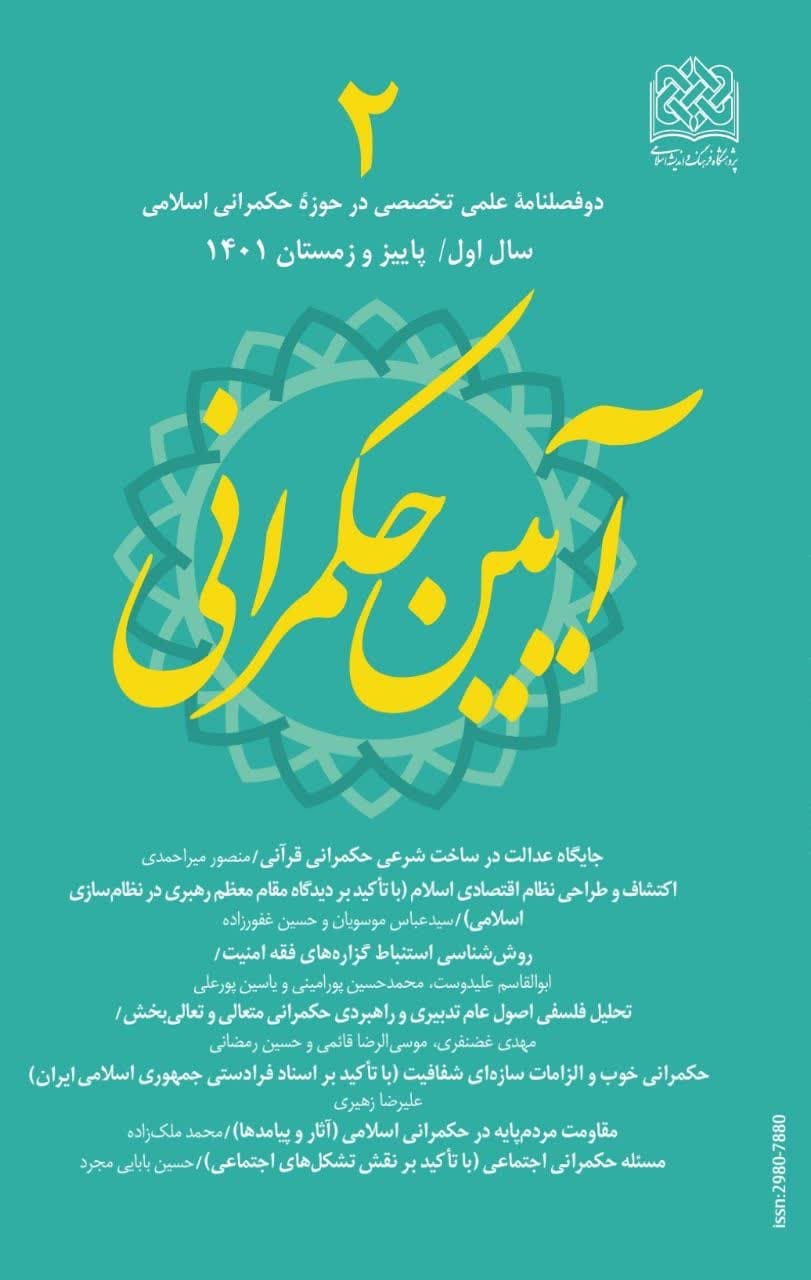
نوع مقاله : مقاله پژوهشی
عنوان مقاله English
نویسندگان English
Political governance in the luminous thought of the Holy Qur’an, unlike prevalent materialist models, is not merely an executive mechanism or a contractual arrangement; rather, it represents a profound reflection of the system of beliefs and human perception of the reality of existence, establishing an inseparable connection between the cosmic order (takwīn) and the legislative order (tashrīʿ). An incomplete understanding of these foundations leads to a deficient comprehension of the origin of power, the ultimate purpose of politics, and the relationship between sovereignty, human beings, and the world. Accordingly, the central problem of this study is to identify and analyze the ontological foundations of political governance in the Qur’an and to uncover how these revelatory truths can be translated into a structured political model.
This research adopts a descriptive–analytical method, relying on conceptual analysis and thematic interpretation of Qur’anic verses to examine fundamental elements such as tawḥīd (divine unity), rubūbiyyah (divine lordship), mulk (sovereignty), ḥukm (authority/judgment), and the divine vicegerency of humankind (khilāfah). The findings indicate that political governance in the Qur’anic framework is rooted in the ontological and legislative sovereignty of God. On this basis, political legitimacy—while essentially divine and grounded in truth—intersects in practice with public acceptance. This solid ontological foundation establishes core principles such as justice-centered governance, guidance-oriented authority, responsibility, and the ethical orientation of power, ultimately defining its final aim as the flourishing of human nature (fiṭrah) and the guidance of humanity toward perfection within the framework of servitude to God.
Keywords:
Ontological Foundations; The Holy Qur’an; Political Thought; Political Governance; Divine Sovereignty.
کلیدواژهها English