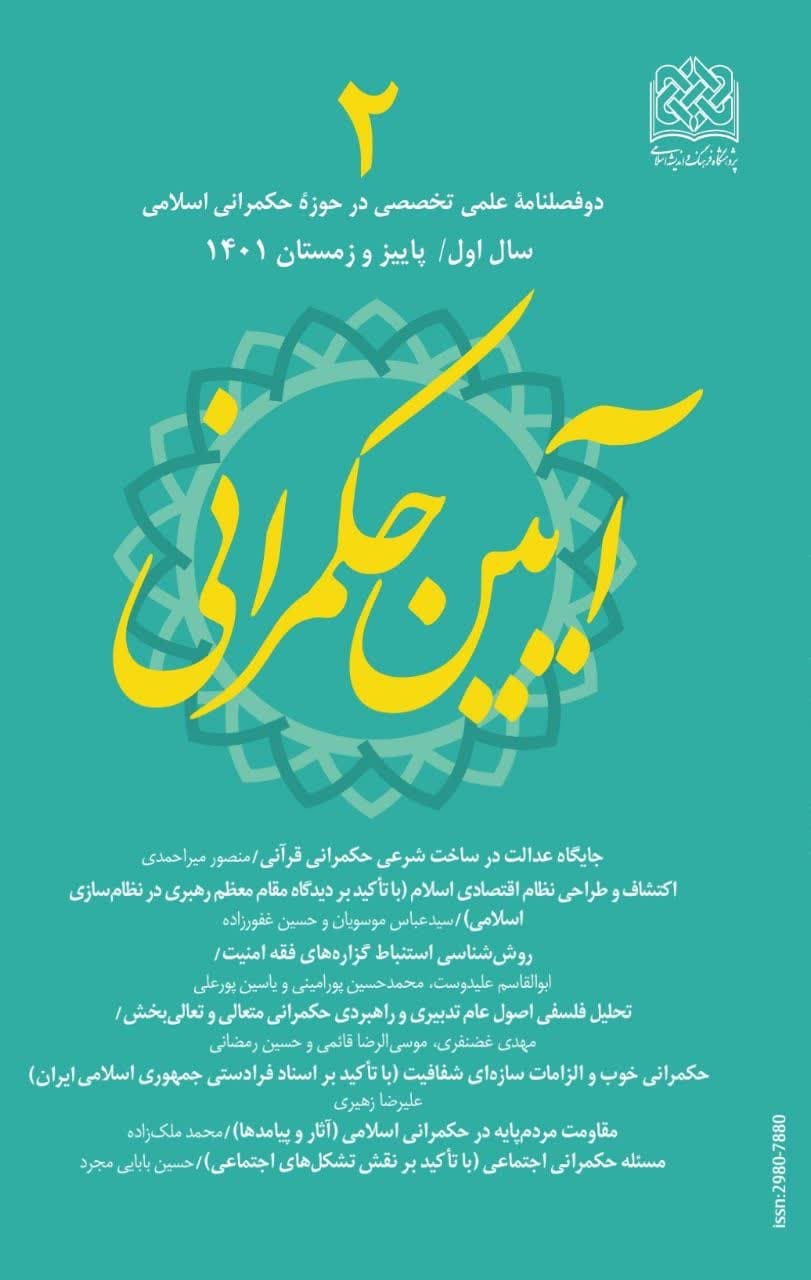
نوع مقاله : مقاله پژوهشی
عنوان مقاله English
نویسندگان English
Abstract
Structuring the framework of the political system and identifying the fundamental principles governing the architecture of power based on revelatory sources stand among the central concerns in the field of Islamic political thought. This is because designing an efficient governance structure necessitates the extraction of authentic rules from the text of the Holy Quran. In this regard, the present study aims to elucidate and propose a comprehensive model of the structural principles of political governance based on Quranic teachings, thereby providing a coherent framework for political system-building. To address this issue, the current study employs a descriptive-analytical method and adopts a thematic exegesis (Tafsir Mawdu’i) approach to conduct an in-depth analysis of verses pertaining to the realms of sovereignty, power, and the administration of society.
The detailed findings of the research demonstrate that the architecture of power within the Quranic model of governance rests upon a coherent, five-fold constellation of structural principles. At the core of this constellation lies the principle of “Divine Sovereignty” as the absolute foundation of legitimacy and legislation. Extending from this core are three interconnected principles: “Structural Justice,” serving as the teleological end of the system and the guiding force for resource distribution; “Consultation” (Shura), acting as the institutionalizing mechanism for collective wisdom; and “Service,” functioning to transform the nature of power toward the provision of public interests. This conceptual network is ultimately consummated by the principle of “Public Participation and Universal Oversight.”
Ultimately, this research concludes that the synergy of these principles orchestrates the body of the political system in such a manner that power is transformed from an instrument of domination into a divine-popular trust (Amanat). Consequently, the governmental structure attains immunity against monopolization, corruption, and inefficiency.
کلیدواژهها English