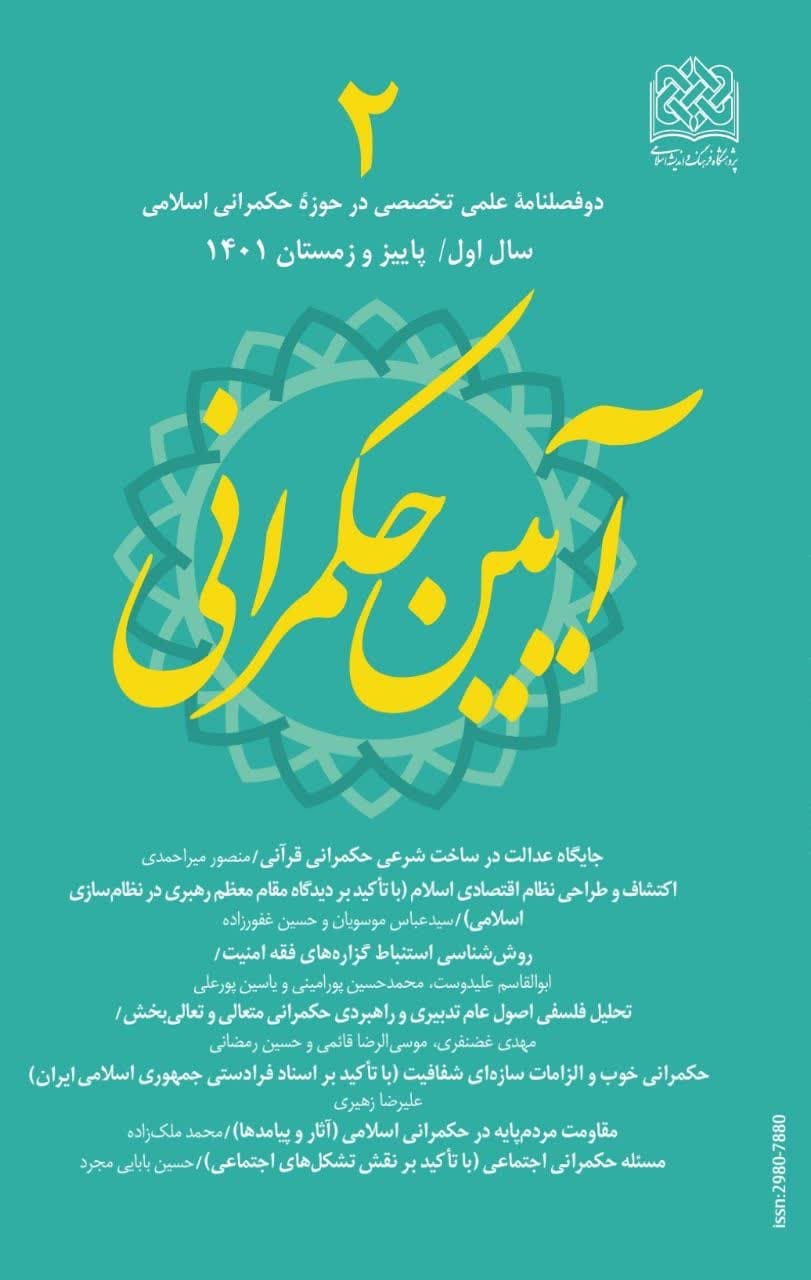
نوع مقاله : مقاله پژوهشی
عنوان مقاله English
نویسنده English
The cultural system in Islamic thought is not simply a set of symbols, rituals, or behavioral patterns, but rather a cognitive, normative, and directional mechanism that forms the main foundation of governance and civilizational life by producing meaning, organizing values, and creating social cohesion. Contrary to the reductionist views prevalent in modern social sciences, this system is not symbolic, superstructure, or subordinate to economic and political structures, but is the fundamental layer of social guidance and the source of legitimacy, identity, and cultural order. The present study examines the ontological, epistemological, and anthropological foundations of culture in Islam, as well as its relationship with the social system and cultural governance, by raising the question of how it is possible to design and reproduce the Islamic cultural system within the horizon of cultural governance. In this regard, while criticizing the secular and human-centered foundations of modern cultural theories, the capacity of civilizational ijtihad has been explained as a methodological framework for extracting sustainable principles, rules of action, and institutional patterns of Islamic culture. The findings show that the realization of Islamic cultural governance requires a link between revelation, ijtihad rationality, and the historical experience of Islamic society, and without having indigenous theorizing, it will not be possible to design an efficient and civilization-building cultural system. Also, the Islamic cultural system can only be effective at the governance level if it can translate fundamental values and meanings into institutions, policies, and executive mechanisms and establish a balance between fixed religious elements and changing social requirements. This article, using a descriptive-analytical method and based on documentary studies, seeks to provide the necessary theoretical foundations to explain the model of Islamic cultural governance and rethink the mechanisms of its realization at the macro-social and civilizational level.
کلیدواژهها English